The four point inspection form used by virtually every insurance carrier in Florida — and required by Citizens Property Insurance Corporation — is officially designated as Form Insp4pt 03 25, last updated in March 2025. Before the form gets into the four systems themselves, the first thing you see is a set of general requirements and advisories that apply to the entire inspection. These are easy to skim past, but they contain some of the most important language on the entire form.
A — Actual Year Built / Date Inspected
These two fields establish the baseline for the entire report. The “Actual Year Built” is the year original construction of the home was completed — not when you bought it, not when the last renovation was done, but when the structure itself was originally built. The “Date Inspected” is the date the inspector physically visited the property and performed the inspection. This date matters because your 4-point inspection is generally valid for one year from this date, and some insurance companies — particularly for lender-placed insurance situations — may require the inspection to be dated within as few as 10 days of the policy application.
B — Minimum Photo Requirements
This box outlines the minimum photographs the inspector is required to include with the completed report. The form lists them with checkboxes: each side of the dwelling, each slope of the roof, the water heater, under-cabinet plumbing and drains, exposed valves, the main electrical service panel with the interior door label visible, the electrical box with the dead front panel removed, and photographs of all hazards or deficiencies noted in the report. These are the minimum requirements — most experienced inspectors will take significantly more photographs than this to ensure the report is thorough and to protect against any questions from the underwriter reviewing it. Every photograph becomes part of the official record submitted to the insurance company.

IMPORTANT: KNOW YOUR RIGHTS – Please read the following if you are told by an insurance company that they will not allow you to chose your own inspector, or they tell you they are using an unlicensed, untrained, unqualified person to inspect your property

The following sections of the form discussed below — labeled C and D from Page 1, G and H from Page 3, and E and F from Page 4 — should be a given. They state plainly who is qualified to perform this inspection and who gets to choose the inspector. But they are worth examining closely, because there is a documented history of some insurance companies denying homeowners the right to have their property inspected by a professional of their own choosing, and of insurance companies sending unlicensed, unqualified individuals to perform inspections that the form itself — seven separate times across its four pages — states must be completed by a licensed Florida professional.
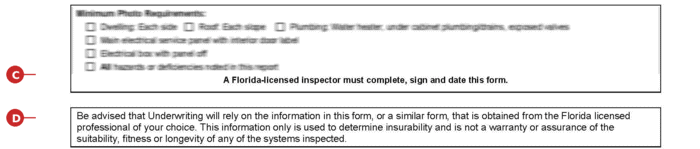
C — “A Florida-licensed inspector must complete, sign and date this form.”
This line is printed in bold on the form itself, and it means exactly what it says. The inspection must be performed, the form must be completed, and the document must be signed and dated by an individual who holds a valid Florida license authorizing them to perform this type of inspection. Acceptable license types include a licensed home inspector, a general, residential, or building contractor, a registered architect, a professional engineer, or a building code inspector authorized by the State of Florida. The form is not valid if it is completed by an unlicensed individual, regardless of who they work for or who sent them.
D — The Underwriting Advisory: “Florida licensed professional of your choice”
This is the section of the form that deserves the closest reading. The full text of this advisory states: “Be advised that Underwriting will rely on the information in this form, or a similar form, that is obtained from the Florida licensed professional of your choice. This information only is used to determine insurability and is not a warranty or assurance of the suitability, fitness or longevity of any of the systems inspected.”
There are two critical things happening in this language.
First, it makes clear that the information on this form is used solely to determine whether the insurance company is willing to insure your home. It is not a guarantee that your systems are in good shape, will last a certain number of years, or are free from hidden problems. The inspection is a visual assessment performed on one day, and the form documents what was observed. Nothing more.
Second — and this is the part worth paying attention to — the form explicitly states that the inspection is to be obtained from “the Florida licensed professional of your choice.” That language is not accidental. It means the homeowner selects and hires the inspector. You choose who inspects your property. You pay them. They work for you. The report is then submitted to the insurance company as part of the underwriting process, but the inspector is your professional, not theirs.
The form does not stop making this point on Page 1. It continues on Page 3 and again on Page 4.
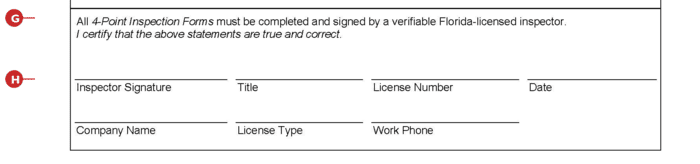
G — Inspector Certification (Page 3)
At the bottom of Page 3, directly above the signature block, the form states it again: “All 4-Point Inspection Forms must be completed and signed by a verifiable Florida-licensed inspector.” Immediately below that, the inspector certifies in writing: “I certify that the above statements are true and correct.” This is not boilerplate — the inspector is placing their professional credibility and their license behind every finding on the form.
H — The Signature Block (Page 3)
The form does not simply ask for a signature and move on. The signature block requires the inspector to provide their License Number and License Type as mandatory fields, alongside their signature, title, company name, date, and work phone number. This is the enforcement mechanism. The form is not relying on the inspector’s word that they are licensed — it requires them to record their actual license number on the document so that it can be independently verified through the State of Florida’s licensing records. An unlicensed individual cannot fill in this block truthfully. If a license number is absent, fabricated, or unverifiable, the form is invalid on its face.
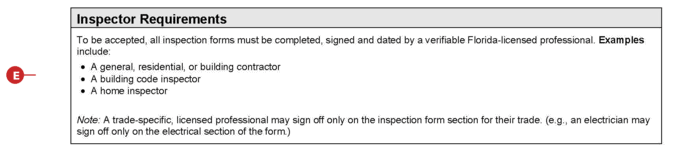
E — Inspector Requirements (Page 4)
Page 4 of the form restates the licensing requirement yet again: “To be accepted, all inspection forms must be completed, signed and dated by a verifiable Florida-licensed professional.” It then lists examples of acceptable license types — a general, residential, or building contractor, a building code inspector, and a home inspector — and adds a note that a trade-specific licensed professional, such as an electrician, may sign off only on the section of the form that falls within their trade. The word “verifiable” is important here. It means the inspector’s license can be looked up and confirmed through the State of Florida. It is not enough to simply claim to be licensed — the license must exist in the state’s records and be active.

F — Documenting the Condition of Each System (Page 4)
Immediately following the Inspector Requirements section, the form states it yet again: “The Florida-licensed inspector is required to certify the condition of the roof, electrical, HVAC and plumbing systems.” It then defines what “Acceptable Condition” means — that each system is working as intended and there are no visible hazards or deficiencies. This ties the licensing requirement directly to the act of certifying the condition of the four systems. The inspector is not simply filling out paperwork — they are putting their license behind a professional certification that the systems are or are not in acceptable condition.
Seven Times Across Four Pages
To put a number on it: the 4-point inspection form references the requirement for a licensed Florida professional seven separate times across its four pages.
- Page 1: “A Florida-licensed inspector must complete, sign and date this form.”
- Page 1: “obtained from the Florida licensed professional of your choice.”
- Page 3: “All 4-Point Inspection Forms must be completed and signed by a verifiable Florida-licensed inspector.”
- Page 3: The signature block requires the inspector’s License Number and License Type as mandatory fields — enforcing the requirement through documentation, not just language.
- Page 4: “all inspection forms must be completed, signed and dated by a verifiable Florida-licensed professional.”
- Page 4: “A trade-specific, licensed professional may sign off only on the inspection form section for their trade.”
- Page 4: “The Florida-licensed inspector is required to certify the condition of the roof, electrical, HVAC and plumbing systems.”
That is not ambiguity. That is not a suggestion. The people who wrote this form went out of their way to make the licensing requirement unmistakable. And yet, as documented below, it has been disregarded.
Why This Language Matters: A Note on Your Rights
Despite what the form itself says — seven times — there have been documented cases in Florida where insurance companies have told homeowners that they must use the company’s own inspector and cannot hire their own. In some cases the insurer covered the cost; in others the homeowner was required to pay for an inspector they did not choose and had no say in selecting.
This is not a hypothetical concern. In 2023, WLRN News and the Miami Herald published an investigation revealing that Citizens Property Insurance had been ordering hundreds of thousands of additional home inspections using contractors whose field inspectors were not licensed by the State of Florida. These inspections — referred to internally as “General Condition” inspections — were being performed by companies contracted by Citizens at rates as low as $32 per property. Homeowners reported that the resulting reports were filled with factual errors: a dirty fence listed as “rotted,” cat hair on crown molding described as “mold,” a neighbor’s tree photographed at a deceptive angle to make it appear to be overhanging the homeowner’s roof. In multiple cases, these error-filled reports led to policy cancellations or dramatic premium increases that were only reversed after the homeowner spent hours — in one case over 100 phone calls and emails — fighting the inaccuracies.
Citizens acknowledged to WLRN that the field inspectors used in the program were not licensed by the State of Florida. The Insurance Information Institute, an industry-funded trade organization, called the practice “alarming” and stated that property insurers typically use licensed inspectors who provide objective analysis, and that companies not following that standard was “very troubling.” Citizens maintained that while unlicensed field inspectors gathered the data, all decisions were reviewed by licensed inspectors and underwriters. The company did not appear to be violating any existing regulation, but it was not following what the industry itself considers best practice — or what its own form requires.
The conflict of interest in this arrangement is difficult to ignore. When the entity deciding whether to insure your home is also the entity controlling the inspection — employing the inspector (often times unlicensed, untrained and unqualified) , and receiving the report — the independence that the form’s own language envisions is gone. The form says “professional of your choice.” An insurance company overriding that choice and substituting its own inspector, particularly an unlicensed one, undermines the integrity of the process that the form itself establishes seven times over.
If you are ever told by an insurance company that you must use their inspector and cannot hire your own licensed professional to complete your 4-point inspection, that is a red flag. You have the right to ask questions, push back, and — if necessary — contact the Florida Department of Financial Services, the Florida Office of Insurance Regulation, or consult with an attorney who handles insurance disputes. The form was written with the expectation that you would choose your own inspector. That language is there for a reason — and the authors of the form thought it was important enough to say it seven times.
[Return to the main “Understanding the 4-Point Inspection Form” page
Curious how much a Four Point Inspection Report will cost for your home? Get a Free Online Estimate in Less than 10 Minutes.