What Is a 4-Point Inspection?
A 4-point inspection is a focused evaluation of four specific systems in your home — roofing, electrical, plumbing, and HVAC — that is required for certain homes (most often age-based) by your insurance company in the state of Florida to determine whether those systems are in acceptable condition for coverage. It is not a general home inspection. It is a targeted, insurance-driven assessment that documents the age, type, condition, and material of each system, supported by photographs, and submitted to your insurer as part of the underwriting process.
If you own a home in Florida and have been asked for a 4-point inspection, it is because your insurance company wants to understand the risk they are taking on before issuing or renewing your policy. The inspection exists entirely for their benefit — it tells them whether the four systems most likely to generate costly claims are in working order, or whether there are conditions present that they are not willing to insure. That is the full scope of what this inspection does. It answers the insurance company’s questions about four systems and nothing else.
Who Needs One and When
There is no Florida state law that mandates a 4-point inspection. It is not a statutory requirement like the wind mitigation inspection credits outlined in Florida Statute §627.0629. The 4-point inspection is an insurance industry requirement — individual carriers decide when and whether to require one as a condition of issuing or renewing a policy. That being said, I would seriously scrutinize any company that does not require a 4-point inspection on a home over 20 years old if you are shopping around or changing companies. The reason I say this is that virtually all reputable insurance companies require it. They do this because they want to see the condition of the home they are insuring. I would question why that one company does not, especially when they are in the business of bean counting.
With that in mind, it is required often enough that most Florida homeowners will encounter it at some point. The most common trigger is the age of the home. Citizens Property Insurance requires a 4-point inspection for all applications on properties more than 20 years old. Most private carriers follow a similar threshold, though some set it at 25 or 30 years, and a few require it for homes as young as 15 years old. The trend across the industry has been moving toward requiring it earlier rather than later.
Beyond home age, a 4-point inspection is commonly required when you are applying for a new policy — whether because you just purchased a home, you are switching insurance carriers, or your previous insurer has dropped you. Some carriers also require an updated inspection at renewal, particularly for older homes, to confirm that the systems documented in the previous report have not deteriorated. Unlike a wind mitigation inspection, which is valid for five years, a 4-point inspection is generally valid for only one year.
What the Inspection Covers
The inspection evaluates exactly four systems. No more, no less.
- Roof — The inspector documents the type of roof covering(s) (shingle, tile, metal, flat, etc.), its age, its overall condition, and an estimate of its remaining useful life. This is the section that generates the most issues for homeowners, because insurance carriers assign specific life expectancies to different roofing materials and generally will not insure a roof with fewer than five years of estimated life remaining. Citizens and most private carriers use general benchmarks — roughly 20 years for standard asphalt shingles, less for three-tab shingles, and 25 to 30 years for tile. If the roof has visible damage, missing material, active leaks, or signs of prior leaks, that will be documented. If only a portion of the roof has been replaced, the inspector must note what percentage was updated and when.
- Electrical — The inspector examines the main electrical panel, including its brand, age, amperage, and condition. They document the type of wiring present throughout the home — copper, aluminum, cloth-jacketed, or a combination. Specific panel brands are known problems. Federal Pacific (Stab-Lok) and Challenger electrical panels have well-documented histories of safety issues and are flagged by virtually every insurance carrier. Single-strand aluminum branch wiring, commonly found in homes built during the 1960s and 1970s, is another significant concern — if it is present, insurers typically require documented proof that remediation has been performed by a licensed electrician using an approved method such as COPALUM crimping or AlumiConn connectors. The 2025 update to the Citizens form added new fields specifically requiring inspectors to identify multistrand aluminum wiring and cloth-jacket rubber-insulated wiring, two types that were being frequently misidentified or overlooked under the previous version of the form. Beyond the big-ticket items, more common issues like double-tapped breakers — where two wires are connected to a single breaker terminal that is only rated for one — are found regularly and must be documented.
- Plumbing — The inspector identifies the types of supply and drain piping throughout the home (copper, PEX, CPVC, galvanized, cast iron, polybutylene, ABS, etc.) and documents the age and condition of the water heater. Polybutylene piping, which was widely installed in Florida homes from the late 1970s through the mid-1990s, is one of the most significant red flags on a 4-point inspection. It has a well-documented history of premature failure and is considered uninsurable by most carriers. Galvanized steel supply lines, which corrode from the inside out over time, are also commonly flagged. The water heater is evaluated for age, condition, and the presence of a temperature and pressure relief (TPR) valve — and critically, whether that valve has a proper discharge pipe routed to the exterior or to an appropriate drain location. A missing or improperly routed TPR discharge pipe is one of the most frequently found issues on a 4-point inspection. It is usually an inexpensive fix, but it must be addressed before the report will be accepted.
- HVAC — The inspector documents the age and condition of the heating and cooling system, including the air handler and condensing unit. Insurance carriers want to confirm that the home has a functioning central heat source — homes that rely solely on portable heaters or window units may face coverage challenges. Most central HVAC systems in Florida have a useful life of roughly 15 to 20 years, and systems approaching or exceeding that range will be noted. The inspector checks for visible leaks, unusual corrosion, and general signs of whether the system appears to have been maintained.
Who Can Perform the Inspection
The inspection must be completed, signed, and dated by a verifiable Florida-licensed professional. Citizens and most private carriers accept the following: a licensed home inspector, a general, residential, or building contractor, a building code inspector, a registered architect, a professional engineer, or a building code official authorized by the State of Florida to verify building code compliance. A trade-specific licensed professional — such as an electrician or a plumber — may sign off only on the section of the form that falls within their trade.
What This Inspection Is Not
A 4-point inspection is not a home inspection. A full home inspection is a comprehensive evaluation of the entire property — structure, foundation, interior, exterior, windows, doors, insulation, ventilation, appliances, and much more. It is typically performed for the benefit of the buyer during a real estate transaction and is designed to give the buyer a complete picture of the property’s condition.
A 4-point inspection does none of that. It answers four specific questions for the insurance company and nothing else. It does not evaluate anything outside of those four systems, it does not assess the overall condition of the home, and it is not performed for the benefit of the homeowner — though the information it reveals can certainly be useful. If the inspection identifies a Federal Pacific panel in your garage or polybutylene supply lines in your walls, that is something you now know about regardless of what the insurance company does with it.
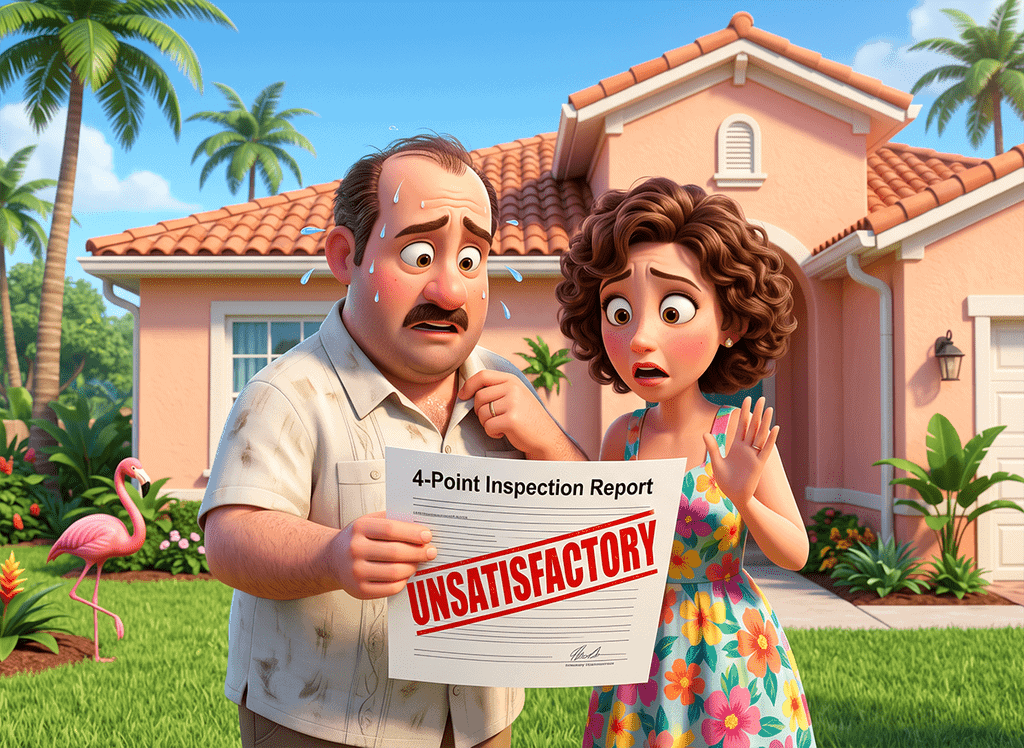
Unlike a wind mitigation inspection, which is not a pass-or-fail evaluation, a 4-point inspection is. Each category or item is marked either Satisfactory or Unsatisfactory. If even one item is marked Unsatisfactory, insurance companies will require a passing report before they will insure you. Some issues are outright deal-breakers for most carriers — Federal Pacific panels, polybutylene piping, a roof with no remaining useful life. Others are conditions a carrier may accept with an endorsement, a higher premium, or a requirement that the issue be corrected within a specified timeframe, but this is not a common occurrence. Since Hurricane Ian, insurance companies have grown increasingly strict, and by limiting yourself to the smaller pool of companies willing to make exceptions, you may be missing out on a better rate elsewhere (I’m not an insurance agent, so that is just speculation on my part). Many homes — particularly newer construction or well-maintained homes that have had systems updated over the years — go through the process without any issues at all.
The Difference Between a 4-Point Inspection and a Wind Mitigation Inspection
These two inspections serve entirely different purposes and should not be confused with one another, even though they are often scheduled together and performed by the same inspector during the same visit.
The 4-point inspection determines whether an insurance company is willing to insure your home. It is a risk assessment. The wind mitigation inspection determines how much you will pay for that insurance. It is a discount assessment. The 4-point inspection documents potential liabilities. The wind mitigation inspection documents verified wind-resistant construction features that entitle you to premium credits under Florida law.
The Roof Inspections Are Not the Same
Even though both inspections involve the roof, they are evaluating entirely different things. In a wind mitigation inspection, the roof portion is performed from inside the attic. It is focused on what holds the roof in place — the structure, the connections, the deck attachment. The only exterior concern is the roof covering material and the geometry of the roof shape. In a 4-point inspection, the roof evaluation is the opposite. The interior ceilings are scanned for visual signs of leaks, and the rooftop itself is photographed in detail from above to document the condition, age, and remaining life of the covering material. Same roof, two entirely different inspections looking for two entirely different things.
Both inspections are important. But they answer different questions, use different forms, are governed by different rules, and produce different outcomes. If you need both, having them done at the same appointment is the practical approach — but understand that they are two separate inspections with two separate reports.
Preparing for Your 4-Point Inspection
Understanding the 4-Point Inspection Form
How the 4-Point Inspection Came to Exist
The Relationship Between the 4-Point Inspection and Your Roof
A Note About This Site This site is focused specifically on 4-point inspections as they apply to homes in Southwest Florida — primarily the Cape Coral, Fort Myers, Bonita Springs, Naples, Punta Gorda, and surrounding Lee and Collier County areas. This is the region we know best, and the examples, photos, and references throughout this site will reflect that.
Florida is a large and geographically diverse state, and while the 4-point inspection process and form are used statewide, some construction types, building code requirements, insurance carrier preferences, and regional considerations can vary depending on where you live. If you are outside of the Southwest Florida area, the general information here will still be useful, but there may be differences that apply to your specific region that are not covered on this site.
Copyright © 2026 SWFL Home Inspector LLC – All Rights Reserved.