The electrical system section is often the most consequential part of the entire 4-point inspection. It is where the most common deal-breakers are found, where the most frequently occurring minor deficiencies show up, and where the difference between an experienced inspector and an inexperienced one becomes most apparent. The form breaks this section into several parts.

A — Electrical System Header and Aluminum Wiring Advisory
The section opens with a note printed directly into the header: “Separate documentation of any aluminum wiring remediation must be provided and certified by a licensed electrician.” This is not a suggestion — it is a requirement. If the inspector identifies aluminum wiring in your home and remediation has been performed, the documentation proving that work was done must accompany the report as a separate attachment. A verbal assurance or a handwritten note is not sufficient. The insurance company will want to see a written statement from a licensed electrician confirming that the remediation was completed using an approved method. Without that documentation, the aluminum wiring will be treated as unremediated, and the report will reflect that.
B — Main Panel / C — Second Panel
The form provides space for both a main panel and a second panel because many Florida homes — particularly larger homes, homes with additions, or homes with detached garages — have more than one electrical panel. For each panel, the inspector documents whether it uses circuit breakers or fuses, the total amperage, and whether that amperage is sufficient for the home’s current usage. Most modern single-family homes in Southwest Florida have 200-amp service. Older homes may still have 100-amp panels, which can be sufficient for a smaller home but may be flagged if the home has been expanded or updated with additional electrical demands. Homes that still use fuse boxes rather than circuit breaker panels will almost always draw scrutiny from the underwriter — fuse panels are not inherently dangerous, but they are outdated technology that most carriers view as a higher risk.
The brand of the panel matters significantly here, even though there is no checkbox for it in this section of the form. Federal Pacific Electric (FPE) panels with Stab-Lok breakers and Challenger electrical panels have well-documented histories of breakers failing to trip during an overload, which creates a serious fire hazard. If the inspector opens your panel and sees either of these brands, that will be documented and it will be a problem. Most insurance carriers will not insure a home with a Federal Pacific or Challenger panel until it has been replaced by a licensed electrician.

D — Wiring Types: Cloth Wiring and Knob-and-Tube
This section asks the inspector to indicate whether certain types of wiring are present in the home. Cloth wiring — wiring insulated with a fabric-based jacket rather than modern thermoplastic — is common in homes built before the 1960s. Over time the cloth insulation deteriorates, cracks, and can expose the conductor beneath it. Its presence does not automatically fail the inspection, but it will be noted and some carriers may require further evaluation or remediation depending on its condition. Active knob-and-tube wiring, which predates cloth wiring and was common in homes built in the early 1900s through the 1940s, is a more significant concern. It is an ungrounded system with no equipment ground, and the ceramic insulators and open-air wiring runs are not compatible with modern insulation or usage demands. Most carriers will not insure a home with active knob-and-tube wiring.
E — Branch Circuit Aluminum Wiring
This is the checkbox that changes the trajectory of the inspection for homes built during the late 1960s and 1970s, when single-strand aluminum wiring was widely used as a cost-effective alternative to copper for branch circuits — the wiring that runs from the panel to your outlets, switches, and fixtures. The problem with single-strand aluminum branch wiring is that aluminum expands and contracts at a different rate than the copper or steel terminals it connects to, which over time can cause loose connections, arcing, and overheating at those connection points. This has been directly linked to house fires, and it is one of the most serious findings on a 4-point inspection. If this box is checked, the form requires the inspector to describe the usage of all aluminum wiring present and to provide details of any remediation that has been performed.
F — Approved Remediation Methods: COPALUM and AlumiConn
If single-strand aluminum branch wiring is present, the form asks specifically whether the connections have been remediated using one of two approved methods: COPALUM crimping or AlumiConn connectors. COPALUM is a proprietary cold-weld crimp connection that permanently joins the aluminum wire to a short copper pigtail, which is then connected to the terminal. It is considered the gold standard for aluminum wiring remediation but requires a specially trained and certified electrician with the specific COPALUM crimping tool. AlumiConn connectors are set-screw lug connectors that create a separation between the aluminum and copper conductors, preventing the direct contact that causes the problems. Both methods must be installed by a licensed electrician, and as the form header states, separate documentation of the work must be provided. Simply telling the inspector “it was remediated” is not enough — the paperwork from the electrician who performed the work needs to accompany the report.
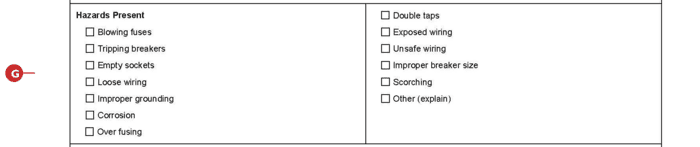
G — Hazards Present
This is a checklist of specific electrical hazards the inspector evaluates while examining the panel and the visible wiring throughout the home. Each one checked means the inspector observed that condition, and each one has implications for your report.
Some of these are common and relatively inexpensive to correct. Double taps — where two wires are connected to a single breaker terminal that is only designed to accept one — are one of the most frequently found issues on a 4-point inspection. They are easy to spot, easy to fix, and a licensed electrician can typically resolve them quickly. Exposed wiring and loose wiring are also common findings, particularly in garages, attics, and unfinished areas where wiring may have been modified over the years without proper attention to code.
Others are more serious. Scorching on or around a breaker indicates that overheating has occurred, which is a potential fire hazard. Improper breaker size means a breaker is rated for more amperage than the wire it protects can safely carry — for example, a 20-amp breaker on 14-gauge wire that is only rated for 15 amps. This defeats the purpose of the breaker entirely, because the wire can overheat before the breaker trips. Over fusing is the fuse-panel equivalent of the same problem. Improper grounding indicates that the home’s grounding system is not connected or not functioning as intended, which is both a safety hazard and a code issue.
Any hazard checked on this list will need to be explained and documented with photographs. Depending on the severity, it may result in an Unsatisfactory rating for the electrical system.
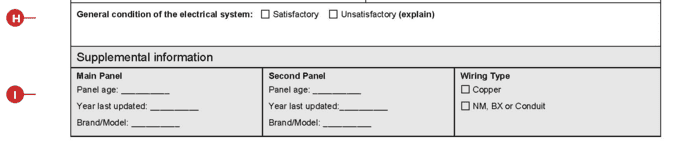
H — General Condition: Satisfactory or Unsatisfactory
This is the bottom line for the electrical section. The inspector evaluates everything documented above — the panel brand, the wiring types, the amperage, the presence or absence of hazards — and makes a determination: is the electrical system in satisfactory condition, or is it not? If any of the hazards above are present and uncorrected, or if the panel brand or wiring type is a known problem, this box will be marked Unsatisfactory with an explanation. As discussed on the main page of this guide, an Unsatisfactory mark on any system means the insurance company will require the issue to be resolved before they will accept the report and issue or renew your policy.
I — Supplemental Information
This section captures the details that the underwriter uses to assess the age and history of your electrical system. For each panel — main and second — the inspector records the panel age, the year it was last updated, and the brand and model. The brand is particularly important here because this is where the specific panel identification ends up on the official record. Even if the hazards checklist above is completely clean, a Federal Pacific or Challenger brand name in this field will trigger the same result: the carrier will require replacement before issuing coverage.
The wiring type field — Copper or NM, BX or Conduit — documents the general wiring method used throughout the home. NM (non-metallic sheathed cable, commonly known by the brand name Romex) is the standard in most modern residential construction. BX is armored cable with a flexible metal jacket. Conduit refers to wiring run through rigid or flexible metal or PVC piping. Copper wiring in any of these delivery methods is what insurers want to see. If the home has a mix of copper and aluminum, both will be noted.
[Return to the main “Understanding the 4-Point Inspection Form” page]
Are you ready to have a 4-Point Inspection? Looking for an Estimate? Get your Four Point Inspection Quote in about 10 minutes or Less.